| Transcribed from handwritten notes by Henry Broadway Griffiths. He prepared them for the cousin of Florence Griffiths, who was visiting from Canada in 1962. The document was found recently in the effects of his cousin’s daughter, who contacted the current owners of Ridware Hall, Roy Edwards & Emma Thomas. Eileen and Ed Barbeau have given permission for these notes to be posted on the Hall website |
| Before 1066, Ridware, pronounced Rhydwar, folk of the river, was held by only 6 families from the earliest records at the time of the Conquest was held by Algar (Saxon). When William the Conqueror invaded England at the Battle of Hastings. Sire-de-Rosny was one of William’s knights whose name is inscribed in the rolls of knights in Battle Abbey, not far from Pevensy where William landed (this is verified by HBG). For his help at the Battle of Hastings, Sire de Rosny was awarded lands north of the Trent at Rhydwar (taking all Algar lands). He built his castle and changed his name to Malvoisyn (interpreted “bad neighbour”). Malvoisyn was not content with the lands William had given him but he fought the neighbouring lords and so became possessed of one great estate. His son was also a warlike lord and went to fight in the Crusades afterwards, being brought home and was buried in the Trinity Aisle of Mavesyn Ridware church. His tomb can be seen. (A Crusader is always buried with one leg crossed over the other the higher the point of crossing the more Crusades in which he had fought). The grandson of the Sire de Rosny was a peaceful person and said that no effort had been made by his father or grandfather to show any recognition of all the wealth of which they had become possessed and naturally being R.C. [Roman Catholic] he founded a priory at Blithbury (2 miles away from Ridware) for the Benedictine Order of Monks there. This being done he said [that] we have no church, so he built the first church of Mavesyn Ridware in 1140. He said we have a Priory, we have a Church, but we have no Parson, so he made his own son the first Parson of Mavesyn Ridware. In the old records, it says Hugh Malvoisyn, Clerk in Holy Orders, 1140. Then he said, we have a Priory, a Church, a Parson, but he has no house, so he awarded his son a plot of land in the northern extremity of the Parish on the high ground and erected for him a residence. This is where the present Ridware Hall commences its history. The Parson or Rector then lived there until the male line died out in 1403, at the battle of Shrewsbury. Before the Battle of Shrewsbury, Malvoisyn had his own private Battle on the High Meadows where the Iron Bridge crosses the Trent River. Incidentally, this Iron Bridge, which as its name implies, was made at Ironbridge in Shropshire and was reputed to be the largest single span iron bridge in the British Isles and was erected around 1830. It should have been mentioned that the coat of arms which is on the entrance gate to Ridware Hall is a Red Dog’s Head; this signifies that the family was loyal to the King and when an arrow is through the Dog’s Head, this means that the family died fighting on the side of the King which is what happened. The weather vane at Ridware Hall made by HBG is a dog’s head with the arrow through the neck. |
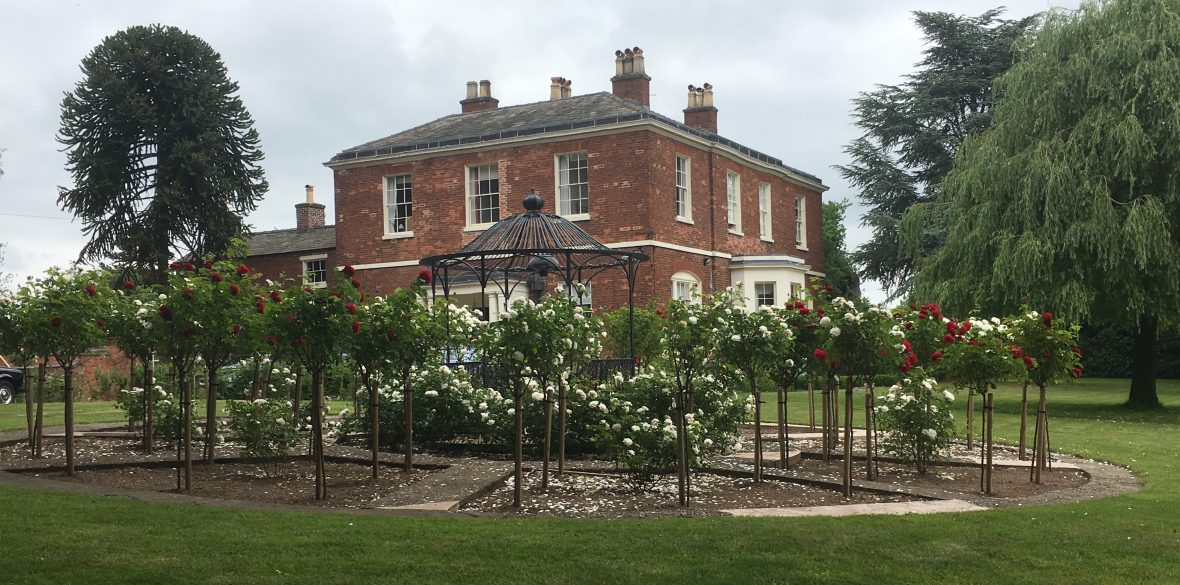
| Mavesyn was a Royalist and Sir William Handsacre the Rival Knight who was descended from the Kings of Scotland and when Percy Hotspur came down to try to take the crown of England; naturally both knights espoused the opposite cause. A feud existed between the two knights. Mavesyn (note the name had changed this time from Malvoisyn to Mavesyn) said that Handsacre’s men were always stealing his fish from Oxonholm Pool. A fish pond was always around a Castle (in the event of being beseiged food was available). Handsacre said Mavesyn held up the water in the river and was unable to drive his bulls. Riparian rights were more jealously guarded than they are today. At the private battle which is depicted on two bas reliefs in the Trinity Aisle at Mavesyn Church shows Handsacre being killed by Mavesyn who then went to Shrewsbury, he being killed a week later on July 20, 1403. Thus ended the male line of Mavesyn. Mavesyn left two daughters; Handsacre left one son who married one of the daughters of Mavesyn and so brought the two families together as well as making one vast estate. The issue married into the Bagot family, de Ferrers, and other noble families. The warriors’ coat of arms in the church bear this out. A stained glass window in the eastern wall of the Trinity Aisle which is insured for £1000 shows the history of the church from the time of the original Malvoisyn up to 1852. Eventually the family became known as Chadwick but always had to carry up the name of Mavesyn. Hence the preponderance of HMC in the church: Hugo Mavesyn Chadwick, [John de] Heley Mavesyn Chadwick. Between 1403 and 1700, the Castle and Church were generally falling into decay. The castle was eventually pulled down leaving only the Gatehouse which has just been (1962) restored by the Ministry of Works at a cost of over £2000. The church was rebuilt in brick in 1782. Ridware Hall was also rebuilt in 1782 and has not been altered since (cannot carry out any alterations without the consent of the Ministry of Works who incidentally call in periodically to take photographs and also to compare with previous photographs). In 1876, one of the daughters of the Chadwicks then occupying Ridware Hall had to have a marriage dowry of £76,000 (seventy-six thousand pounds). She wanted a title, so married Lord Cecil who had a title but no money. She said that she did not want to see any portion of the estate sold to bring in the amount of money but would be content with 2|% on this £76000. The Chadwick family continued to live at Ridware Hall and were great benefactors to the villagers and farmer tenants alike. Every six months when rents were paid in a big room at the Chadwick Arms Inn, the poorer children were measured for enough cotton for dresses for the girls and cloth for the boys. The post that carries the Chadwick Arms Inn sign was cut down from near the Hall about 60 years ago and has only been painted about 4 times since. I should have mentioned that Rent Day was a notable occasion. All the tenants and estate employees were entertained to a grand dinner and entertainments. Much of this information was given to HBG by Mr Derry who was the estate manager, who died about 2 years ago and was over 90. He told me that rents of the workers’ cottages were never more than ls3d per week and the Chadwick Farm rents were also low. However, the estate dwindled through gambling and other causes at the beginning of this century and was merged into Trent Mersey Estates as a holding company who finally disposed of the remaining parts of the Chadwick Estates. The last part was Ridware Hall and 9 acres, and which had always been HBG’s life ambition. It came onto the open market in 1934-5 when it was purchased by HBG. The outside has not been altered, nor was there any reason to do so. The brick work, Flemish Bond is a beautiful example of craftsmanship. The inside house has been thoroughly modernised and can so be run with the minimum of labour. It is a friendly house; one can feel the friendliness as soon as one steps into the Hall, and everyone expresses the same opinion. Since the house was purchased in 1934 someone strange comes into the house every week and who has not been seen before. To be continued later. |
| Below are some marginal notes in the manuscript. Ridware Hall was conveyed to us in 1935 and during that time up to the present day, August, 1962, Florence and I have only slept in the house by ourselves 14 times. It was sequestered in 1939 and held until 1949 by the WD [War Department] and the Ministry of Agriculture. The Italians were the best occupants and the conscientious objectors the worst. Florence and I get great joy in sharing the house with other people. I had better dry up. I notice it is after midnight yet could go on for hours yet. We like having people like you to stay. HBG The original house would be built of local stone. The present brick structure was built on old stone foundations. The stone quarry where the old stone came from to built the church, castle, hall id about 1 mile from Ridware Hall at Blithbury. |
 Ridware Hall